Sunday, April 17, 2016

Dungeons & Manga #2 - Knowing D&D Part Two

OK, let's jump right back into the action. While in part one we saw that the introductory section of the book Knowing D&D began with dynamic action scenes to capture the reader's attention, its latter half is all action art.

This second half of the text is a"replay", or the transcript of a play session. Replays are HUGELY popular in the Japanese TRPG scene, and the rationale seems to be 1) it is fun to read through someone else's session as a fictional account and 2) you can learn to run a game or play in one by reading replays.

Anyway, on to the art. In this part, instead of explaining every image, I will instead present them with questions and let you try to guess what exactly is going on.

First image - where is the best place to start an adventure?


Next, who invited a snake to this disco party?


Make the 1/2 HD mooks jump!


Uh oh, the TPK heavies just showed up...


Where does this lead to?


 Who best to find their way in the darkness...


A reward for bravery.


Splitting the spoils, making plans...


A summons!


These guys good or bad? Depends how they're shaded...


Taking the block.


Not alone!


About those goblins...


Who does your hair, Baal?


Bette Davis eyes?


Always a damsel somewhere...


She didn't see that coming...


Which edition theses guys playing? BECMI by the ads...


Anyway, so much for Knowing D&D. Excuse the photo quality, but my tablet camera at 2am is about all I can muster these days.

I'd like to thank all commenters - I didn't expect any response, especially any so soon or thoughtful. Good to know there are other people with the same interests out there in the nebulous space of the OSR.

Next in the series - scifi TRPG style, or Furries in Space!


Saturday, April 16, 2016

Dungeons & Manga #1 - Knowing D&D Part One

Not having the time to compose the long (winded) discursive thoughts on games I used to, I thought I'd start a new series of posts that would require less time to write for but also provide something interesting for gamers until I can get more time to think and compose. I've turned to my fairly extensive collection of Japanese RPGs, most of which are fantasy games, to present what I call 'Dungeons & Manga', namely manga-style art used in Japanese TRPG books. Whereas English RPGs and D&D in particular took some time before accessing professional artists, Japanese game designers had access to the immense pool of relatively inexpensive manga artists in Japan.

Today, I will be looking at 1987's D&Dがよくわかる本、D&D ga yoku wakaru hon, loosely translated as Knowing D&D Well, or more simply D&D for Beginners. This book is much like a Japanese Judges' Guild resource, and the series it is a part of includes extensively written and illustrated guides on dungeons, monsters, and other RPG accoutrements.

First, the cover (below) presents a whimsical reversal of position of PCs and the dragons they are supposed to be gunning for. It reminds me a bit of the old Dragon magazine comic where adventurers sit around playing an RPG in which they take on the role of office workers. It also shows a high degree of self-deprecating humour, which is still evident in Japanese TRPGs today, but I feel somewhat lacking in self-important western RPGS. Anyway, here it is:


Moving inside, we see that Japanese gamers knew what captured goblins were good for. This is not surprising given the velocity with which unchi rolls downhill in a vertical society...


From the bottom of the dungeon hierarchy we soar to the top. Next stop, dragons!


With the reader's appetite whetted with images of adventure, the tone shifts to tongue-in-cheek comic art to present the classes. There's the fighter:


The top panel is captioned "The fighter is D&D's superstar!!", while the bottom states "However, they are none too smart..." and show the wizard saying "Hey, get back to work!" Unsurprisingly, the next picture is the wizard:


The mage's thought balloon reads "For MU's, choosing the right spell decides your fate." Below that the wizard mumbles "Without magic, I'm just an average human..." and chooses from a golf bag with the words "Fireball", Levitation", "Lightning", "Phantasm" and one other illegible spell name. Next, the cleric:


The cleric thinks "Clerics can't use bladed weapons!" while the elf behind quips "Razors are OK, right?" The bottom caption reads "They have the power to protect the party from undead and injury!" Whereas individualistic westerners might cringe at being in a support position, group-minded Japanese players would instead find supporting the party a worthy and attractive role. In contrast, next up is the thief:


The upper panel reads "The party uses me as a treasure detector..." while the bottom is captioned "The highly dexterous thief also levels up quickly." The thief himself quips "I aim to be guildmaster!", interestingly using the Japanese term 大親分 (o-oyabun, or yakuza chief) to anchor the character in Japanese culture. Moving on to the elf:


The female elf has been a Japanese fantasy trope since Deedlit of Lodoss War, and that archtype is here. The caption on top reads "Elves can fight, use magic, are intelligent, and long lived...". This totally fits the critique of elves as a token instead of individual characters that appeared on Playing D&D with Pornstars, perhaps implying that this simplification is even stronger across cultures. The bottom reads "But their advancement is also incredibly slow." This same simplification is seen with the dwarf:


"Dwarves are small but tough!" reads the caption, evoking Gimli to an almost painfully stereotypical degree. The humouruous bottom quip "Because we eat minerals (just joking)" lightens this image, but unintentionally adds an explanation for dwarvish miserliness and mining that I would add to any mythos I used in game. How about the hafling?


"Haflings are hard to hit" promises the caption, and the character breaks the fourth wall to counsel " You have to be strong, dextrous, and tough if you want to be me!" Here ends the cutesy art and manga style realism returns for the equipment section:


Chainmail, shield, platemail, and leather are all here.


Hand axe, shortsword, battle axe, and two-handed sword as well...


 Mace, crossbow, bow, dagger, and club...


Ending with lance, spear, war hammer,  halberd and sling. What, no katanas? Oh well, now on to character sheets:


For those of you that can read katakana, yes they have named the thief 'Darth Vader' and the wizard 'Ben Kenobi.' If that seems like a jr high D&D camp type of thing to do, remember that they are coming from another culture, and so are not much different from the L4R players who call their PC Musashi or Nobunaga. Similarly, the fighter is Pendragon and the elf is (wait for it)... Legolas. Sigh, there was also a cleric named Rasputin, but my tablet ate the photo, so I shall spare you.


That's it for this installment, tune in next time for the dynamic action scenes accompanying the sample adventure!

If you liked this post or have any suggestions or questions, leave a comment.


Monday, April 4, 2016

Updates Coming....

Soonish!

Seriously, life is so sweet it has left little time for gaming or the escape from reality I needed the last two terrible years. New work is AMAZING, PhD is done, son is growing like a weed, wife and I are... in a truce.

That said, this blog isn't dead, just dreaming. There are pages of ideas and projects I slowly chip at, but publishing for the career this year takes precedence.

Things will go up when they do.

In the meantime, a little sad reality check. THIS POST about misogyny in the tabletop hobby. I can say it half surprised me, but half made me remember the rude comments and rape simulations I saw women players subjected to back in my gaming heyday.

All I'll say is if you're rolling dice and pretending to be a hero in a fantasy world, you can carry some of that back to the real world and stand up against this and any other kind of bullying you see at a gaming table.

As the old X-Files saying goes, "Well hey, I didn't spend all those years playing Dungeons and Dragons and not learn a little something about courage." Be courageous, be the hero you want to be.


Monday, December 7, 2015

I'm Baaack + Class Based Dystopias

Let's see...

The PhD thesis is in.


4 years, 289 pages x 6 copies. Just printing and assembling it took a day.

Next up, work put me on a sabbatical till April. I've signed an NDA and am happy to close that chapter of my life.

If any of you are thinking of doing a PhD, let me say this:

Think again.

Especially if you are married. That supportive spouse will come to resent the time you spend away, and hate how absent minded and unhelpful around the house you've become.

Super especially if you are working to pay your way through. Your job performance will suffer, coworkers and supervisors will hold your feet to the fire more than workers not doing a PhD. If you can, keep it on the QT.

So anyway, back hopefully to blogging, gaming, and generally enjoying life more than I have in recent memory.

Here's my inaugural post as a free man and doctor of philospohy. Very in keeping with my thesis on discourse:


Class Based Dystopias


Ever wonder why there are still kings and queens in the D&D world. If player characters are so powerful, why don’t members of the 4 classes rule every nation?

(PS: I know many D&D products have PC classed NPCs as rulers, this is just a thought exercise with delicious implications).

The answer is that the power corrupts and makes their society inherently unstable. Any nation ruled by a player character class is a dystopia that ultimately comes to a bad end.

Each of these societies has characteristics which can be divided into the Good, the Bad, and the Ugly.

Here’s how it breaks down:

Ruler: Cleric.
Government: Theocracy.
The Good: Priests cast a level higher! Pray sincerely and miracles happen!
The Bad: You’re either with us or against us. Priests of other gods cast as one level lower, save at - 1 vs holy magic of our god.
The Ugly: Inquisitions, burnings, holy wars. This type of nation usually ends when the witch trials and inquisitions get out of hand and people leave the cities, where they are retaken by vegetation in a few years. Or else, they pick an illogical religious war with neighbors, who band together to wipe the floor with them and place a secular or at least non-fundamental regime in their place.
Examples: Berserk by Kentaro Miura

Ruler: Fighter.
Government: Dictatorship.
The Good: Can levy double army size. Arms and armor can be had at rock bottom prices.
The Bad: Violence is always the answer. Everyone is armed or guarded and ready to thrown down at any moment.
The Ugly: To the victor go the spoils, to the loser go pillaging, rape, mass mutilations or beheadings. This type of nation usually ends when the great leader is bumped off by another, or when neighbors band together to send an army or a group of murder hobos to take out the dictator and replace them with a non-PC class figurehead.
Examples: Game of Thrones (? dunno, haven’t seen TV since I started the degree…)

Ruler: Thief.
Government: Kleptocracy.
The Good: Anything can be bought, for the right price.
The Bad: Watch your purse every second.
The Ugly: Assassination is the solution to every problem. Usually such a nation ultimately devolves into a nation of beggars living in the ruins of once nobles cities as thieving skills are not passed or as teachers are strangled or poisoned off.
Examples: Nadsokor (Elric series), Thief Town (Adventure Time)

Ruler: Mage.
Government: Anarchy.
The Good: Potion shops, wand & staff ateliers, flying castles, it is all here, and at rock bottom prices compared to other places.
The Bad: Mundane, non-magical folk become the underclass. Killing them isn’t even a crime.
The Ugly: Monsters, monsters everywhere. Chaotic creatures are drawn to this place, and welcomed with open arms. Eventually the Tarrasque will show up and eat the place whole, or demons will infiltrate the ruling structure and turn it into a hellmouth or warp the kingdom to some shadow plane. Within a generation it is a myth or legend become cautionary tale.
Examples: The Shadow Plane (Elric), Sigil (Planescape), Wizard Town (Adventure Time)


Monday, October 5, 2015

Stop Thinking Hit Points Are Just Health


Hit Points aren’t health. They never were. Or if they were intended to model health in the beginning, they quickly mutated into something else through play. Intentions aside, they are probably the most important invention or convention in gaming, and are used in everything from FRPGs to puzzle games to date sims.

But they don’t make much sense, logically.

A blacksmith has less hit points than a wizard who hangs around dank dungeons. Really?

A wizard can be killed by a cat. Really?

A newbie fighter can be killed with one good blow, but a veteran can take a dozen cuts but soldier on. Really?

The problem with questioning the game mechanics in this way is that D&D isn’t a reality simulation. Ceci n’est pas la verite. Since OD&D, people have tried to add pain calculations, health statuses, and other accoutrements to make Hit Points make logical sense.

These additions miss the point. Hit Points and D&D itself make sense intuitively, not logically. Part of the joy and challenge of roleplaying in general and D&D in particular is wrapping your mind around what story those esoteric character sheets, rulebooks, and dice rolls tell you.
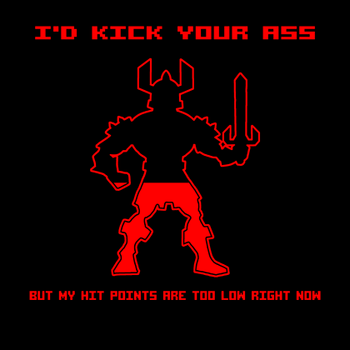
Hit points are how important your character is to the story. If you’re a 1st level mook with a sword or a light spell, you don’t matter. If you’re the diva of the thieves’ guild, you can shrug off a battle-axe.

Intentionally or not, this reflects the literature that inspired the original fantasy game creators. Think of Beowulf. As a young warrior, he and his mates are nearly decimated by a troll and its mother. For a low level fighter, those Claw/Claw/Bites mean death.

As a seasoned fighter, Beowulf takes a dragon on by himself after his servants abandon him. He is taking damage and ultimately perishes, but saving against Breath Weapon and trading blows makes taking the dragon down with him much easier.

This is why D&D and retroclones have been used to emulate everything, from science fiction (White Star, Terminal Space, X-plorers), to superheroes (Mystery Men), to Oriental adventure (Ruins & Ronin, Shinobi & Samurai), and Westerns (Go Fer Yer Gun, Blood & Bullets). Hit points make great narrative, intuitive sense.

D&D is not realistic or logical. But it has a real feeling that we intuitively acquire, a verisimilitude that draws us in. DMs should capitalize on this, not let a mistaken desire for ‘reality’ to mar the immersion of fantasy that is the magic of roleplaying.

So stop describing combat as hit or miss. A sword stroke may cleave an armored novice priest in twain, but the same roll and damage is barely a scratch to a high priest wearing nothing but robes. A fireball wipes out a party of murder hobos, leaving ashen silhouettes on the ground, but rolls over the Defenders of the Realm, who grit their teeth and hunker down under their shields before returning fire.

So DMs, don’t fight the concept of Hit Points with your head. Accept them with your heart and let them tell their story through you.

One could also free Hit Points from the tyranny of damage, alleviating the whittle down effect of combat. How about burning HP for a reroll, letting them stand in for Luck or Hero Points? Hit Points thus become a pool of narrative ‘bennies’ that can be burned to let players get what they want, but at the risk that their story may end prematurely.

In the next game I run, Hit Points will go unchained. No plan survives contact with the enemy, as they say, so I’ll let you know how it goes. If you take this idea and run with it, tell me where it worked and didn’t.

(PS Blogging ice age is coming to an end, as is gaming life and social life. Feels good)

Monday, January 12, 2015

Broken by 2014

So anyway, 2014 broke me.

Between the PhD deadlines (which I failed and now have till May to pass), the four hour daily commute to a job I desperately tried to get out of (and failed - here's looking at you year two at Peach Pit U), and the black hole of mutual loathing that my marriage has become, I don't know how I am still breathing, let alone sane.

The first causality of this real life implosion was, of course, the gaming and blogging that is my escape hatch and release valve.

2015 has been much kinder. I've had a relaxing trip to an onsen spa, my little boy is the love and light that keeps me going, the wife is treating me human again, the job wraps up in ten days so I can concentrate on getting the degree done, and I played a game of the new Star Wars miniature rules.

I have a backlog of posts that will have to wait until the degree is done and I am off the academic hazing hamster wheel. This is first priority. Expect regular blogging to resume after that, along with gaming, hopefully.

Hope you all are having as much good fortune in the new year as I have enjoyed thus far.

PS* I tried to read 5E but the prose is pretty languid and pedantic. Days like these I miss High Gygaxian or Mumbly Mearls.