Soonish!
Seriously, life is so sweet it has left little time for gaming or the escape from reality I needed the last two terrible years. New work is AMAZING, PhD is done, son is growing like a weed, wife and I are... in a truce.
That said, this blog isn't dead, just dreaming. There are pages of ideas and projects I slowly chip at, but publishing for the career this year takes precedence.
Things will go up when they do.
In the meantime, a little sad reality check. THIS POST about misogyny in the tabletop hobby. I can say it half surprised me, but half made me remember the rude comments and rape simulations I saw women players subjected to back in my gaming heyday.
All I'll say is if you're rolling dice and pretending to be a hero in a fantasy world, you can carry some of that back to the real world and stand up against this and any other kind of bullying you see at a gaming table.
As the old X-Files saying goes, "Well hey, I didn't spend all those years playing Dungeons and Dragons and not learn a little something about courage." Be courageous, be the hero you want to be.
Monday, April 4, 2016

Monday, December 7, 2015
I'm Baaack + Class Based Dystopias
Let's see...
The PhD thesis is in.

4 years, 289 pages x 6 copies. Just printing and assembling it took a day.
Next up, work put me on a sabbatical till April. I've signed an NDA and am happy to close that chapter of my life.
If any of you are thinking of doing a PhD, let me say this:
Think again.
Especially if you are married. That supportive spouse will come to resent the time you spend away, and hate how absent minded and unhelpful around the house you've become.
Super especially if you are working to pay your way through. Your job performance will suffer, coworkers and supervisors will hold your feet to the fire more than workers not doing a PhD. If you can, keep it on the QT.
So anyway, back hopefully to blogging, gaming, and generally enjoying life more than I have in recent memory.
Here's my inaugural post as a free man and doctor of philospohy. Very in keeping with my thesis on discourse:
Class Based Dystopias
The PhD thesis is in.

4 years, 289 pages x 6 copies. Just printing and assembling it took a day.
Next up, work put me on a sabbatical till April. I've signed an NDA and am happy to close that chapter of my life.
If any of you are thinking of doing a PhD, let me say this:
Think again.
Especially if you are married. That supportive spouse will come to resent the time you spend away, and hate how absent minded and unhelpful around the house you've become.
Super especially if you are working to pay your way through. Your job performance will suffer, coworkers and supervisors will hold your feet to the fire more than workers not doing a PhD. If you can, keep it on the QT.
So anyway, back hopefully to blogging, gaming, and generally enjoying life more than I have in recent memory.
Here's my inaugural post as a free man and doctor of philospohy. Very in keeping with my thesis on discourse:
Class Based Dystopias
Ever wonder why there are still kings and queens in the D&D world. If player characters are so powerful, why don’t members of the 4 classes rule every nation?
(PS: I know many D&D products have PC classed NPCs as rulers, this is just a thought exercise with delicious implications).
The answer is that the power corrupts and makes their society inherently unstable. Any nation ruled by a player character class is a dystopia that ultimately comes to a bad end.
Each of these societies has characteristics which can be divided into the Good, the Bad, and the Ugly.
Here’s how it breaks down:
Ruler: Cleric.
Government: Theocracy.
The Good: Priests cast a level higher! Pray sincerely and miracles happen!
The Bad: You’re either with us or against us. Priests of other gods cast as one level lower, save at - 1 vs holy magic of our god.
The Ugly: Inquisitions, burnings, holy wars. This type of nation usually ends when the witch trials and inquisitions get out of hand and people leave the cities, where they are retaken by vegetation in a few years. Or else, they pick an illogical religious war with neighbors, who band together to wipe the floor with them and place a secular or at least non-fundamental regime in their place.
Examples: Berserk by Kentaro Miura
Ruler: Fighter.
Government: Dictatorship.
The Good: Can levy double army size. Arms and armor can be had at rock bottom prices.
The Bad: Violence is always the answer. Everyone is armed or guarded and ready to thrown down at any moment.
The Ugly: To the victor go the spoils, to the loser go pillaging, rape, mass mutilations or beheadings. This type of nation usually ends when the great leader is bumped off by another, or when neighbors band together to send an army or a group of murder hobos to take out the dictator and replace them with a non-PC class figurehead.
Examples: Game of Thrones (? dunno, haven’t seen TV since I started the degree…)
Ruler: Thief.
Government: Kleptocracy.
The Good: Anything can be bought, for the right price.
The Bad: Watch your purse every second.
The Ugly: Assassination is the solution to every problem. Usually such a nation ultimately devolves into a nation of beggars living in the ruins of once nobles cities as thieving skills are not passed or as teachers are strangled or poisoned off.
Examples: Nadsokor (Elric series), Thief Town (Adventure Time)
Ruler: Mage.
Government: Anarchy.
The Good: Potion shops, wand & staff ateliers, flying castles, it is all here, and at rock bottom prices compared to other places.
The Bad: Mundane, non-magical folk become the underclass. Killing them isn’t even a crime.
The Ugly: Monsters, monsters everywhere. Chaotic creatures are drawn to this place, and welcomed with open arms. Eventually the Tarrasque will show up and eat the place whole, or demons will infiltrate the ruling structure and turn it into a hellmouth or warp the kingdom to some shadow plane. Within a generation it is a myth or legend become cautionary tale.
Examples: The Shadow Plane (Elric), Sigil (Planescape), Wizard Town (Adventure Time)
Monday, October 5, 2015
Stop Thinking Hit Points Are Just Health
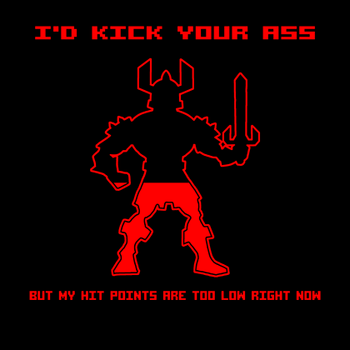
Hit Points aren’t health. They never were. Or
if they were intended to model health in the beginning, they quickly mutated
into something else through play. Intentions aside, they are probably the most
important invention or convention in gaming, and are used in everything from
FRPGs to puzzle games to date sims.
But they don’t make much sense, logically.
A blacksmith has less hit points than a
wizard who hangs around dank dungeons. Really?
A wizard can be killed by a cat. Really?
A newbie fighter can be killed with one
good blow, but a veteran can take a dozen cuts but soldier on. Really?
The problem with questioning the game
mechanics in this way is that D&D isn’t a reality simulation. Ceci n’est pas la verite. Since
OD&D, people have tried to add pain calculations, health statuses, and
other accoutrements to make Hit Points make logical sense.
These additions miss the point. Hit Points
and D&D itself make sense intuitively, not logically. Part of the joy and
challenge of roleplaying in general and D&D in particular is wrapping your
mind around what story those esoteric character sheets, rulebooks, and dice
rolls tell you.
Hit points are how important your character
is to the story. If you’re a 1st level mook with a sword or a light
spell, you don’t matter. If you’re the diva of the thieves’ guild, you can
shrug off a battle-axe.
Intentionally or not, this reflects the
literature that inspired the original fantasy game creators. Think of Beowulf.
As a young warrior, he and his mates are nearly decimated by a troll and its
mother. For a low level fighter, those Claw/Claw/Bites mean death.
As a seasoned fighter, Beowulf takes a
dragon on by himself after his servants abandon him. He is taking damage and
ultimately perishes, but saving against Breath Weapon and trading blows makes
taking the dragon down with him much easier.
This is why D&D and retroclones have
been used to emulate everything, from science fiction (White Star, Terminal
Space, X-plorers), to superheroes (Mystery Men), to Oriental adventure (Ruins
& Ronin, Shinobi & Samurai), and Westerns (Go Fer Yer Gun, Blood &
Bullets). Hit points make great narrative, intuitive sense.
D&D is not realistic or logical. But it
has a real feeling that we intuitively acquire, a verisimilitude that draws us
in. DMs should capitalize on this, not let a mistaken desire for ‘reality’ to
mar the immersion of fantasy that is the magic of roleplaying.
So stop describing combat as hit or miss. A
sword stroke may cleave an armored novice priest in twain, but the same roll
and damage is barely a scratch to a high priest wearing nothing but robes. A
fireball wipes out a party of murder hobos, leaving ashen silhouettes on the
ground, but rolls over the Defenders of the Realm, who grit their teeth and
hunker down under their shields before returning fire.
So DMs, don’t fight the concept of Hit
Points with your head. Accept them with your heart and let them tell their
story through you.
One could also free Hit Points from the
tyranny of damage, alleviating the whittle down effect of combat. How about
burning HP for a reroll, letting them stand in for Luck or Hero Points? Hit Points
thus become a pool of narrative ‘bennies’ that can be burned to let players get
what they want, but at the risk that their story may end prematurely.
In the next game I run, Hit Points will go
unchained. No plan survives contact with the enemy, as they say, so I’ll let
you know how it goes. If you take this idea and run with it, tell me where it
worked and didn’t.
(PS Blogging ice age is coming to an end, as is gaming life and social life. Feels good)
Tuesday, August 25, 2015

Monday, January 12, 2015
Broken by 2014
So anyway, 2014 broke me.
Between the PhD deadlines (which I failed and now have till May to pass), the four hour daily commute to a job I desperately tried to get out of (and failed - here's looking at you year two at Peach Pit U), and the black hole of mutual loathing that my marriage has become, I don't know how I am still breathing, let alone sane.
The first causality of this real life implosion was, of course, the gaming and blogging that is my escape hatch and release valve.
2015 has been much kinder. I've had a relaxing trip to an onsen spa, my little boy is the love and light that keeps me going, the wife is treating me human again, the job wraps up in ten days so I can concentrate on getting the degree done, and I played a game of the new Star Wars miniature rules.
I have a backlog of posts that will have to wait until the degree is done and I am off the academic hazing hamster wheel. This is first priority. Expect regular blogging to resume after that, along with gaming, hopefully.
Hope you all are having as much good fortune in the new year as I have enjoyed thus far.
PS* I tried to read 5E but the prose is pretty languid and pedantic. Days like these I miss High Gygaxian or Mumbly Mearls.
Between the PhD deadlines (which I failed and now have till May to pass), the four hour daily commute to a job I desperately tried to get out of (and failed - here's looking at you year two at Peach Pit U), and the black hole of mutual loathing that my marriage has become, I don't know how I am still breathing, let alone sane.
The first causality of this real life implosion was, of course, the gaming and blogging that is my escape hatch and release valve.
2015 has been much kinder. I've had a relaxing trip to an onsen spa, my little boy is the love and light that keeps me going, the wife is treating me human again, the job wraps up in ten days so I can concentrate on getting the degree done, and I played a game of the new Star Wars miniature rules.
I have a backlog of posts that will have to wait until the degree is done and I am off the academic hazing hamster wheel. This is first priority. Expect regular blogging to resume after that, along with gaming, hopefully.
Hope you all are having as much good fortune in the new year as I have enjoyed thus far.
PS* I tried to read 5E but the prose is pretty languid and pedantic. Days like these I miss High Gygaxian or Mumbly Mearls.
Friday, October 17, 2014
Roguelike Lessons
As for myself, I simply LOVE Roguelikes,
especially this Nethack in which you'll find many of my ghosts littered about. The biggest criticism KTR makes is that
Roguelikes have no balance in terms of scaling encounters, and he uses the term
‘difficulty cliff’ to differentiate from the ‘difficulty curve’ of games like
Destiny or RPGs like D&D 4E.
I think he has misunderstood the appeal of Roguelikes,
at any rate ones like the one I play. There is no difficulty curve, nor is
there a cliff. There is just pure chaos. You are just as likely to find a Wand of Death as to run into a
goblin holding one. You WILL die at some point. I am not a ‘get off my lawn’
grognard, nor a masochist. I just don’t have time for a difficulty curve that
strings me along forever – I WANT the game to end badly.
The idea of a difficulty curve is anathema
to me. If you like having the game adjust for you, which I found both boring
and somewhat patronizing in the few 4E games I played, then have at it. Some
people play Monopoly, others obscure Teutonic boardgames, others poker, none is
better, each suits a different taste or lifestyle.
Playing Roguelikes suits my life right now,
but they also have valuable lessons for tabletop DMing.
1 Dungeons Should Be Breakable – Although
there was a lot of posts about Jacquaying dungeons a few years back, i.e.
allowing multiple entrance and egress points and thus avoiding topographic
railroads, Roguelikes blow this out of the water. In Nethack, pick up a pick
axe or mattock and you can make your own damn entrances and exits, even between
levels. Or dig a pit, stand on the far side and let monsters tumble in, slay
them and take their stuff. The pick axe is the ultimate tool of agency. However,
the time and energy spent digging also tires the character and draws attention,
which brings us to the next lesson…
2 You should know what you’re getting into –
Anyone complaining about dying in a game of D&D, unless they are dealing
with a dick DM and their complaint is about them and not the game, seems to
have misunderstood the game and its setting. You are a murder hobo in a world
red in tooth and claw and out to get you. Dying is not a question of ‘if’ it is
a matter of ‘when’ unless you retire the character or switch to another game.
Which brings us to….
3 If you don’t like it, there are other
games – This sounds so trollish on the interwebs, but make no mistake I am not
trying to troll KTR. If Roguelikes seem broken or unfun to you, find something
that does work and is fun for you. I cannot stand poker – it just bores and
confuses me. Everyone at my workplace loves it and has poker nights, which I
skip. Unfriendly? Maybe, but better than me starting to resent some wonderful
coworkers just because our tastes differ. And speaking of social effects of
gaming…
4 Alignment should have social effects –
Alignment in D&D is often a stick to keep character’s actions in line with
some ideal. Too often there is little ‘carrot’ to balance this out. In Nethack,
creatures of a similar alignment do not attack one another automatically. You
may want to strip a pick axe off a dwarf in the mine level, but if you’re a
lawful Valkyrie, you’ll have to find a store selling one. If you decide to
ignore your alignment and kill a dwarf, you’ll be asked if you really want to,
and your dwarficide will worsen relations with your god, who can uncurse
objects and may even bestow legendary items on you if you sacrifice to them.
This is a wonderful mechanic, and one that I would add to my own D&D games.
Speaking of house rules…
5 Games should be hackable – Like Dwarf
Fortress but on a smaller scale, Nethack allows players to use the elements of
the system and setting in ways that have unforeseen consequences. If you plan
on stealing from a shop, digging a circle of pits around the shopkeeper will
keep them from chasing you (but you’ll have to sneak your pick axe into the
store in a sack first or be denied entrance). If you cast a spell while drunk
or confused, it may have altered effects, and I have inadvertently created rustproof armor
and weapons this way. Tabletop RPGs should allow for even more unforeseen
flexibility than Nethack with its limited programmed elements, and a DM not
taking advantage (or letting players take advantage) of this flexibility is
missing out on the greatest feature of the game itself.
So, go out there and play a Roguelike
today. You may not like the overall experience, but you will learn something,
whether to do or to avoid, that will improve your DMing and make your game suit
your style and needs more.
Thursday, October 16, 2014
The Other, OTHER Monster Manual & Whatever Happened to Tedankhamen?
Found another great monster manual tonight,
Eric Carle’s Dragons Dragons. That’s
right, Eric Carle, the author of The Very
Hungry Caterpillar, wrote a monster guidebook. I don’t know for certain
whether Carle ever played RPGs, but the title certainly evokes the old Tunnels
& Trolls book Monsters Monsters.

If you have kids (what, gamers
procreate?!?), this book is a must tool of indoctrination for future polyhedral
rollers. It was a big hit with my one year old munchkin.
The book is a beautiful hardcover with
Carle’s characteristically colorful paintings of monsters drawn from the
familiar Eurocentric myths but also some outliers from South America, Africa
and Japan.
Each image is accompanied by a poem, mostly from authors I’d never heard of
except biggies like William Blake. The book ends with a neat little section
explaining the mythical origins of the creatures featured.
The list of monsters has interesting
implications for a gameworld based on it. They are as follows:
Dragon (fire breathing green on the cover)
Drake (inside cover)
Dragon
Roc
The Yeti
Minotaur
Basilisk/Cockatrice
Leviathan
Amphisbaena
White Buffalo
Woman
Rainbow Crow
The Phoenix
The Griffin
The Unicorn
Pan
Kappa
The Centaurs
Mermaid/Undersea
Chinese Dragon (big pull out splash
centerpage)

Ganesha, Ganesh
Sphinx
Pegasus
Bunyip
Garuda
Quetzalcoatl

Kraken
Cerberus
Chimera
The Hippocamp
Anansi the Spider
Okolo the Leopard Warrior
The Manticore
Dragon
Any fantasy campaign run with this book as
its monster manual would feature a lack of lootable evil demihumans and a load
of heavy hitting monsters and demigods, thus would probably feel like Shadow of Colossus, with PCs running
from most encounters or trembling in abject terror. The book’s selection makes
it more of a mix of Monster Manual
and Deities & Demigods than
straightforward monster book.
Anyway, great mind and eye candy for little
ones of all ages.
As to where I have been, the answer is
trapped under the burning timbers of my phd thesis. My plan back in September
of providing an antidote to the tsunami of D&D 5E posts fell through, but
on the good side I have one chapter deadline to go this month, a final edit
next month, then freedom.
Wish me luck, and expect posts infrequently
until December when I’ll be diving into blog and gaming therapy for my stress
and exhaustion.
Tedankhamen
Subscribe to:
Posts (Atom)