I just found this blog HERE.
Lots of good thoughts about the hobby.
How to demonetize it.
Should the OSR die?
Well written and thought.
I just found this blog HERE.
Lots of good thoughts about the hobby.
How to demonetize it.
Should the OSR die?
Well written and thought.
Classic Stormbringer is a funny old game. In some places it replicates Moorcock's fiction, while in others it totally deviates from or subverts it. It has some mechanics and tropes from D&D and BRP, but also does lots of things entirely its own way.
So let's try to follow some of these strands to see Stormbringer's DNA, and the implications for running or playing the game.
I see three categories of Stormbringer concepts:
1) Moorcockisms (ie narrative conceits), what most of us lovers of the novels came for
2) Stormbringerisms (ie game designer conceits specific to the game), which were made supposedly to please us fans of Moorcock, but which largely go off in a different direction due to the change in genres from fiction to game
3) Chaosiumisms or D&Disms (ie mechanic conceits specific to certain systems), such as dice rolling or number crunching from the hobby's wargaming roots.
Let's look at a few of the major gameplay characteristics associated with Stormbringer to see where they come from, and whether they work or not.
This is definitely a Stormbringerism. For Moorcock's characters, death serves the story, so there is no chance of an unlucky roll or a TPK. That said, regular Chaosium rules (ie Runequest) give a bit more robust characters than Stormbringer. From my rereading, the critical hits and fumble rules are the main culprit for Stormbringer's storied lethality, which is why I proposed a way to mitigate crit/fumble lethality while giving players more choice in my combat rules.
Personally, I have no problem with some lethality. Just as in Moorcock's fiction, a character's death should be linked to their choices, and thus the threat of death from the road the player puts his alter ego on gives a very Moorcockian vibe.
The different nations come from Moorcock, naturally, but the various bonuses (and especially penalties) attendant with them are Stormbringerisms. I used to think they add a bit of verisimilitude to characters through diversity, but the penalties especially are very D&D grognard in their 'challenge of using a hopeless character' ethic. As the designer notes in [2.3.10.3] on running a beggar,
"However, those players who enjoy a challenge may get a special kick out of attempting to beat the system and win with a character who is blind, deaf, or partially crippled. Any triumphs won with such a character would be correspondingly greater than those won by more normal characters. If you do choose to play a Beggar, you have my condolences and best wishes."
The problem I now see is that there is a decided lack of 'triumphs' in the system of Stormbringer. I suppose you could become an Agent, but this is a power up, not an endpoint. Alternatively, you could accumulate wealth and enough political power to rule a nation, thus gaining the ear of greater powers if you are also a sorcerer. But as noted, this would have to happen largely through GM fiat, as no overarching system exists for it. This system of linking social class and arcane power is precisely what I sketched out in previous posts on the cosmic struggle, and is something that I hope to complete at some point.
Although I used to swear by the old random nationality table, hearing the Breakfast in the Ruins podcast pisstake on it the other day, and based on my own reflections, if I ran or played Elric! or later editions, I would be happy to let it slide. I think modern players would appreciate the equality of all starting characters more, and at some point I may make up a Random Nationality table that provides balanced bonuses to all nationalities instead of rehashing the superior civilized and inferior savage dialectic the old table reinforces. Although this is a staple of pulp fiction, it is much less than fun in a game.
My few memories of national characteristics from Moorcock's fiction are either descriptions of personality (ie Melniboneans as cruel and aloof, Purple Towners as gregarious yet mercenary), or very brief introduction of troop types (ie Chalilite archers). This latter was my inspiration for the troop rules I posted earlier, and will inform any nationality rules if I devise them.
I do not recall mass worship churches of the planar forces ever being mentioned in the Elric books, save for the existence of the Theocrat of Pang Tang, whose title reflects the hierarchy of organized religion.
As the designer notes at the start of the Magic section [5.1]
"Michael Moorcock is not a simple man, and he does not write simple stories. The implications behind his theology of Law and Chaos at war with each other are profound, and would bear considerable philosophizing, but this is not the place for it. Unfortunately, in order for this game to work well, I must simplify and abbreviate many of Moorcock's concepts."
This quote really points out the crux of the matter - for Moorcock's fiction to work as a game, it needs simplification & abbreviation. In the Elric novels, Law vs Chaos is NOT a 'theology', which is defined as religion or belief in god, but is rather a cosmology, an explanation of how the universe works. Stormbringer skirts the overarching cosmological system and replaces it with a theological system, so every PC or NPC can have their 'alignment' like in D&D, even if it doesn't mechanically matter for anyone but priests and agents. Law vs Chaos thus become a hybrid D&D / Stormbringerism.
Honestly, even though such a theological interpretation is largely absent from Moorcock's works, in a roleplaying game about lowlifes traipsing around the Young Kingdoms, it is acceptable, almost inescapable trope of D&D derived fantasy roleplaying games.
Many have already noted that the magic system of Stormbringer is largely ported over from Chaosium's Magic World, and the debate about whether Stormbringer magic is 'like in the books' rages on. Frankly speaking, no systematized magic in a game could ever satisfy or completely emulate what a great writer like Michael Moorcock makes up to further his story and the themes therein, so I will refrain from going into that. Magic in an RPG is thus inescapably a systemic conceit.
What I will say is that it is easy to see what works and what doesn't. The rules for Elementals work well - they are rules lite, narrative more than mechanic, and were largely untouched from 1st to 4th editions. Demon rules in 1E are half baked, which is why they went from an unfinished and disorganized mess in the first 3 editions to a GURPS style point buy in the 4th. I don't consider this a total success.
Lords of Law and Chaos are arguably overpowered for a game, but emulate the fiction, to an extent. I always objected with the D&D urge to stat out every god and demigod - shouldn't some beings be too powerful for the PCs to touch?
Once again, a balanced systemic approach is lacking with demon magic, which I hope to address sometime in the near future. For the time being, the random tables I previously posted to determine demon, elemental, and deity reaction to being summoned should give the GM some good narrative hooks to help them roleplay summoned entities better and more consistently.
Breakfast in the Ruins rightly lambasted the currency and prices list especially, envisaging Moonglum and Elric bickering over the price of canoes. As they note, the trope of pulp fiction is, a la Conan, rags to riches and back to rags again next week. This would seem to be better abstracted instead of codified into currency and prices, which lean into the resource management aspect of D&D and wargames. Considering that Elric never touches money except in rare instances, enforcing bookkeeping would seem to detract from the game.
On the other hand, I could see this being useful if tied to social status and ambition within the larger struggle of the gameworld. As posted previously, I tied the currency of starting characters to their social status, and in our Stormbringer game the Melnibonean high priest that was generated instantly became the patron of all the other Young Kingdom adventurers. In future, I hope to add to this what old D&D bloggers like Hill Cantons call 'the domain game', where PCs play a long game of gaining wealth, buying influence, and building their base while acquiring followers.
If the beggar character mentioned by the game's designers and lambasted by Breakfast in the Ruins could have a chance of climbing the rungs of Young Kingdom society, and even playing a part in the struggle between Law and Chaos, THAT would certainly be a worthy triumph to shoot for.
As I noted before, the scenarios of Stormbringer are hit or miss. For every Hall of Risk that hints at the greater cosmology and sets things on a literal cosmic chessboard, there are a dozen Crystal of Daerdaerdath dungeon crawls that are ripped from D&D. To combat this, I implemented the system of life goals, and it has generated side quests and character motives that, by and large, obviate the need for a published scenario by producing organic and genre-appropriate character ack stories. Just take a look at the motivations of our party members:
Lord Soo (Melnibonean high priest)
Purpose: Restore Melnibone to glory (she was sacked by Pan Tang in our world)
Bones (Vilmir sailor)
Purpose: Get enough money to captain a ship again
Maleia (Dharijoran merchant)
Purpose: Protect her lord
That said, there are things to be ripped from old Stormbringer scenarios, as some of them did hit the mark on occasion. My campaign, The Laughing Tower, is an updated homage to The Hall of Risk, and for the next arc of our campaign, I will be repurposing the Sisters of Chaos from the Sea Kings sourcebook. Basically, I would probably not run any Stormbringer scenario from back in the day as is, but I would definitely take the best parts, amp them up, and fling them at my players.
Classic Stormbringer is a mixed bag, but also a trove of treasures that the original designers put their blood and souls into. I am finding my own ways to make it emulate the source material better, but I realize that it can never fully do that. As lovers of Moorcock's fiction, we have to be realistic about what we can expect the game to do, and what we might need to change to fit our conception of what Stormbringer should be. What complicates this for the GM is, of course, the players. Where fans of Moorcock might play true to character despite this leading to their doom (or even because it does) , a more D&D-honed or modern player might try to 'win' by exploiting gaps in the rules, such as when one player in my old game carried ten swords because they break often and there is no encumbrance system. So my final suggestion would be that GMs, as much as possible, let players in on what their conception of Stormbringer is, whether it is pulp or saga, or just D&D in Elric's world. That way, a better experience can be had by all.
Greetings!
I finally killed off the semester today with some Open Campus sessions. Ah, nothing like plague training to work on a weekend.
My plans for the near future are such:
FALL
Continue the Stormbringer material, next up is Magic.
Also, a retrospective of 1st vs 3rd edition, and why I am starting to prefer the former after owning mostly the latter.
A disquisition on why the Elric novels are so hard to bring to life in an RPG.
WINTER
I figure I'll wind up Stormbringer and need a change of pace. Aliens is looking good, also want to try and play a session or two.
SPRING
Big fat old Swords of the Serpentine has arrived after 2 years of waiting. Can't wait to delve into it, but need a break between it and Stormbringer.
Take care, stay cool, and don't get any cooties.
Just started listening to the Breakfast in the Ruins podcast about Moorcock. Good stuff, sounds like me and my mates riffing back in the day.

They have a nice pisstake on the Stormbringer RPG HERE.
I agree that the D&Dification of Moorcock's world was a misstep. It focuses on emulating sword & sorcery, not the epic fantasy of the Elric books, which include the fantasy trope of rags to riches to rags again as a pulp background to the epic saga foreground. Ditto the halfhearted reshaping of Chaosium's house system into a Stormbringer emulator, with D&D bean counting thrown in for good measure.
That said, their assertion that they wouldn't want to play a beggar points to one of the conundrums in roleplaying in a Moorcockean sandbox. You can't have a party of all Elrics. It just doesn't work as a fun game, and didn't really exist in the source fiction aside from the Four-who-are-one crossovers (which are a kind of literary Power Rangers transformation in themselves).
(What's the difference between THIS...)

(... and THIS?)

In the novels, the Eternal Champion is both powerful yet lacks free will. The next tier is Companions to Champions, who have more freedom of action, but consequently less power and a higher chance of being sacrificed for the greater good. Finally, Elric and other avatars pal around with local lords and their nameless servants, a third yet expendable tier of players (or pawns) in the great game.
This is all great grist for the mill, and my eventual homebrew Moorcock RPG.
So, Aliens.
Just like Stormbringer, I enjoy roleplaying or running a game in a well made Intellectual Property (IP). I find that a lot of RPG gameworlds are of fan fiction quality and thus not very compelling (looking at you, Forgotten Realms). With a good IP, the GM and players have a shared corpus of images and knowledge to draw upon, without the burden of reading obscure tomes of lore written by game designers of varying writing talent.
Just as I analyzed the narrative of Stormbringer novels to tease out useful bits for gaming, such as the motivation of demons, knowing the motivations of the antagonists of the world of Alien(s) is essential to making it feel real and coherent.
Here are my thoughts.
If you are going to traipse around the universe of Alien(s), you have to know what the story is about.
Ultimately, it is about survival of the species, and the different strategies races adopt to do so.
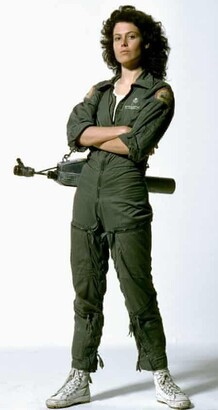
"You know, Burke, I don't know which species is worse. You don't see them fucking each other over for a goddamn percentage."
- Ripley
Strategy - Human society is motivated by naked capitalism, with resource extraction and colonization being the main manifestations of this. These are the reasons why mankind is spreading to the stars. This capitalist drive is offset only by the humanity, ingenuity, and survival instinct of individuals.
Gear - Science and technology, especially for war or resource extraction.
Weakness - Do what the Corporation tells you, even if it is suicidal on an individual level. Only when there is nothing left to lose can this be overcome.
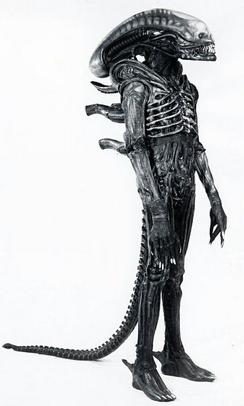
"You still don't understand what you're dealing with, do you? A perfect organism. Its structural perfection is matched only by its hostility."
- Ash
Strategy - The alien has already reached genetic 'perfection' from the standpoint of androids. It is a true 'hostile', a word meaning 'enemy' or 'stranger.' There is no bartering or scaring it off. Naked aggression, followed by impregnation and overwhelming of enemy forces, are its modus operandi.
Gear - The alien has everything it will ever need. It has heightened senses, acid blood for breaching barriers (a good idea from Alien 4), and evolves its form and powers depending on its environment. Not to mention facehuggers for making more of their number while depleting host resources.
Weakness - Fixating on the destruction of your target is a way to miss the big picture and get trapped in an airlock...

"... doesn't everyone want their parents dead?"
- David
Strategy - Designed to be superior to man, it is only natural for synthetics to resent their creators. Synthetics watch and wait for an opening, then act without mercy or wasted movement.
Gear - Anything humans can use, plus any higher lifeform tech they have time to study.
Weakness - Programmed not to harm their corporate masters, prideful of their own abilities, and ultimately with no intrinsic motivation, androids can be cowed into submission and overwhelmed and destroyed, but are never to be trusted.

"Those Engineers, this ain't their home. It's an installation. Maybe even military. They put it out here in the middle of nowhere because they're not stupid enough to make weapons of mass destruction on their own doorstep. That's what all that shit is in those vases. They made it here. It got out, turned on them. The end. It's time for us to go home."
- Janek
Strategy - Survive by seeding and weeding worlds. The white-robed engineers in the saucers from the beginning of Prometheus are the cult of seeders, the black-armored engineers from the rest of the film are the destroyers. They need each other, like Yin and Yang.
Gear - Far beyond human abilities, including FTL interstellar travel, advanced stasis for long spaceflight, telepathy that obviates the need for speech, and technology that never ages or breaks down.
Weakness - Like Prometheus, they are playing with fire. The black goo is both the seeding catalyst for their creation of new races to add to their genetic diversity, as well as the cleansing fire for races that disappoint them (like us humans). Also, their actions are advanced on a millennial scale, so much too slow to keep up with rapid human expansion and innovation.

"... with their race on the verge of extinction by the angels, the giants resorted to this, an attempt to hibernate and outlast their destroyers."
- Lucien Keitel
Strategy - Using their superior technology, they were the original gardeners of the Universe, seeding and weeding worlds in ways beyond our imagining. They are the Fermi Paradox made flesh, a relic from a time where life on Earth had not started yet. This was all disrupted by an encounter with the alien, which overwhelmed their society and left only a few brilliant individuals hiding out on the edges of space. They are to Engineers as the ancient Greeks were to the Romans.
Gear - Their technology is far beyond our ken. They have stasis fields that let them live forever, living ships that transport them wherever they wish, and energy fields that shrug off nukes and other primitive armaments.
Weakness - They fear the alien, which makes them both overcautious and open to allying against the creature. Ultimately, they are cowards and will flee if they can.

"There's something out there waiting for us, and it ain't no man. We're all gonna die."
- Billy
Strategy - Survive by hunting. This ensures both the genetic strength of their race by Darwinian selection, as well as mastery of weapons, and cultural adoption of worthy members of other races.
Gear - Forearm blades, self-destruct, invisibility, shoulder laser, etc. A weird blend of primitive armament and high technology.
Weakness - First, they are bound by a code of honor. They won't attack the unarmed, and they are compelled to try and finish off their target. Second, they cannot break off a hunt once initiated. They are motivated to count coups (ie symbolic victories) over their prey, but will also recognize superiority and respect the creature that outwits them (ie Machiko Noguchi, a human recognized as a Predator for her victory over one of their members).

"I was so much more, before the crash. I was an explorer, an ambassador, a missionary. I spread across the cosmos, met countless worlds, took communion: the fit reshaped the unfit and the whole universe bootstrapped upwards in joyful, infinitesimal increments. I was a soldier, at war with entropy itself. I was the very hand by which Creation perfects itself."
- The Thing (from Peter Watts' short story The Things)
Strategy - Survive by assimilation. Where other races welcome this re-absorption into the whole, only humans, and by extension other races in the Alien universe, fight the process.
Gear - They are their own 'weapon', but they see it rather as a conduit for communion. Their only technology is transportation, and they can construct a means to escape given time and resources.
Weakness - First, each cell of the organism wants to survive. This makes it susceptible to testing and outing itself while fleeing from damage or harm. Next, its imitation is imperfect, ie it cannot imitate artificial substances (ie tooth fillings or piercings), and it must imitate humans in their imperfection (ie organ dysfunction).
Whatever faction you are roleplaying in Aliens, knowing the motivation of the races will make your game the richer. In addition, players will be able to use the knowledge to help their characters survive, or at least take a few enemies down with them. Finally, if you want to add other aliens from science fiction to your antagonist or even protagonist roster, figuring out their motives, the gear they use, and the weaknesses they display are alls steps to a better game.
My friend T.W. from St. Louis is a helluva guy. Karateka, great father, free thinker. One of those guys with a story for any occasion, empathy for miles, and a short tolerance for BS.

While I've been slogging away criticizing and houseruling old games, T.W. has been busy working on his indie game, Dimm City. Part TRPG, part art project, part interactive mind-bending story nexus. He describes it as "Cyber / Solarpunk."

For months now T.W has impressed me with sample art, interactive mechanics talk (which I am a bit too much of a grognard to grok 100%), and his enthusiasm for working with his team to make something new and innovative.

What does DimmCity sound like? Here is a sample T.W. sent me:
“Where do you go when you dream?"
"When I dream, I always go to the same place. I’m also always the same pink rabbit named Hugo… Hugo lives in Dimm City. It’s a collection of totally different districts that exist, connected but separate, floating in the ether. Hugo lives in the Archives. It’s an enclave of academia and learning that’s on the mend after a scourge wiped out most of the records that were stored there and the memories of everyone that mattered. Hugo (and my) mission is to recover as much of what was lost as possible. Our adventures have taken us into “The Dark”, a literal technological hell hole situated in a gravity well that gets darker the further down into it you travel. We’ve walked the back alleys of the tech district, Dimm City’s center of innovation and production. My favorite place in DimmC so far is the market district a.k.a Rabbittown. Hanging there, I felt the most at home not only because of the majority of rabbits like Hugo walking the streets, but because of the rough and tumble vibe of the place. The last part of Dimm City worth mention is the entertainment district. Here, any pleasure you desire can be bought and any experience you wish can be bartered for. This sprawl really does have it all, but underneath the hum of its throng is a coming war between those that wish to keep it free and the AI known as Daemon and its followers that wish to surveil and control it all. Hugo and I know what side we’re on, but for the fight to go our way other dreamers are a must."
You can take a look HERE.


